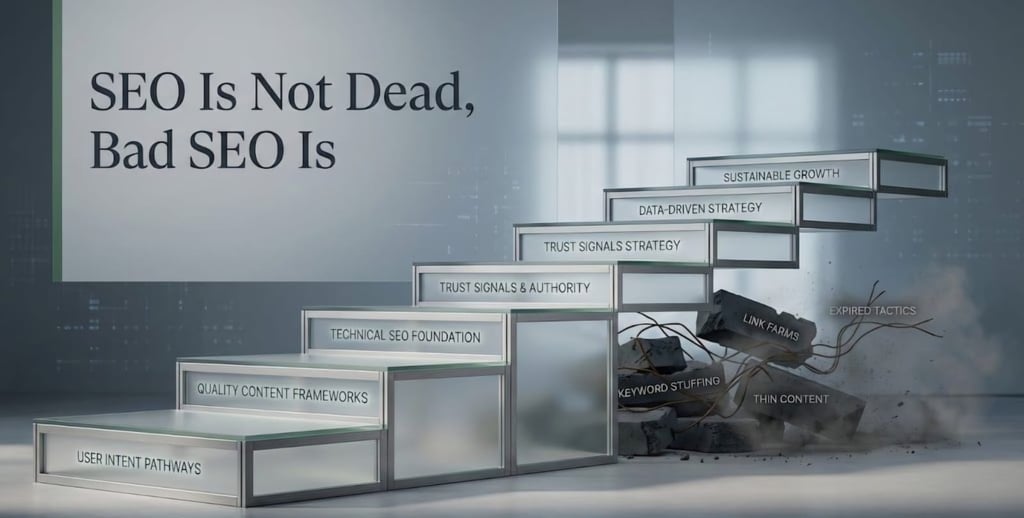
SEO Is Not Dead, Bad SEO Is: What Actually Works in 2025
AI didn’t kill SEO. It raised the bar. Here’s how modern brands use SEO + SGO to win search and trust together.
SEO VS AISEO TRENDS 2025SEARCH ENGINE OPTIMIZATIONSEO IS NOT DEADWHY SEO STILL WORKS IN 2025AI AND SEARCH ENGINES
12/17/20258 min read
SEO Is Not Dead
For years, the marketing industry has repeated the same narrative that SEO no longer works, but this belief usually comes from people expecting search to behave the way it did a decade ago. SEO was never a static tactic; it has always been a system that evolves alongside user behavior, technology, and business models. What people call the “death of SEO” is often just the end of shortcuts that once produced easy wins. Search engines still need to connect users with answers, products, and services, and businesses still need visibility where intent already exists. That fundamental exchange has not changed. What has changed is the level of effort and clarity required to earn that visibility. SEO today rewards depth, relevance, and trust rather than mechanical optimization. If SEO were truly dead, companies would not continue to invest heavily in it, nor would search remain one of the highest-converting acquisition channels across industries.
Why People Are Confused
Many founders and marketers genuinely feel SEO stopped delivering results because the signals they were tracking no longer align with how search visibility actually works. Rankings fluctuate more, SERPs are crowded with ads, snippets, and AI-generated answers, and traffic does not always move in straight lines. This creates the illusion that effort is not being rewarded. In reality, the confusion comes from measuring SEO with outdated expectations. People expect quick wins, linear growth, and direct attribution, while modern SEO is slower to show surface level impact but stronger underneath. When traffic drops after an update, it feels like proof that SEO is broken, even when the real issue is that the strategy never adapted. Confusion thrives when teams focus on vanity metrics instead of meaningful outcomes like qualified traffic, engagement quality, and downstream conversions that search still influences quietly but powerfully.
Outdated SEO Failed
What actually failed was a version of SEO built on exploiting gaps rather than serving users. Keyword stuffing, thin content pages, link manipulation, and templated blogs worked when search engines were less sophisticated. That era created a generation of marketers who learned to game systems instead of understanding audiences. When those tactics stopped working, the assumption became that SEO itself had collapsed. In truth, search engines simply closed the loopholes. Businesses that relied on low effort content mills or copied competitor pages felt the impact first, because they had no real value to defend. Outdated SEO was fragile by design. It depended on scale without substance. Once algorithms started rewarding originality, clarity, and usefulness, those strategies naturally fell apart. This was not a punishment but a correction. The failure of outdated SEO is actually evidence that search is improving, not disappearing.
Search Has Evolved
Search today is less about matching words and more about understanding meaning, context, and intent. Engines analyze behavior patterns, content depth, topical relationships, and real world signals that go far beyond keywords on a page. This evolution reflects how users search now, asking complex questions, comparing options, and expecting immediate clarity. Voice search, conversational queries, and AI assisted results are all extensions of this shift. Search results are no longer ten blue links competing equally; they are layered experiences designed to reduce friction. That does not reduce opportunity for brands, but it does demand better thinking. Websites must communicate clearly who they are for, what problem they solve, and why they deserve trust. Search has evolved from a directory into a decision making assistant. SEO that aligns with this reality thrives, while SEO that treats search like a static index naturally fades.
Intent Matters More
Modern SEO succeeds or fails based on how well it aligns with user intent rather than how aggressively it targets keywords. Two people can search the same phrase with completely different goals, and search engines are increasingly good at recognizing that nuance. Ranking for high volume terms means little if the content does not match what the searcher actually wants to achieve. This is why many sites see traffic without results. They attract visitors but fail to satisfy intent, leading to poor engagement and weak signals over time. Intent-focused SEO requires understanding the journey behind a query, not just the words used. Is the user researching, comparing, or ready to act? Content that answers the correct stage builds relevance naturally. When intent is met consistently, rankings become more stable because the page earns its position through behavior, not manipulation. Intent has quietly become the core currency of search visibility.
Experience Beats Information
Information alone is no longer enough to compete in search because information is everywhere and increasingly generated automatically. What differentiates strong pages now is experience. This includes how content is structured, how quickly value is delivered, and how confidently the page guides the user forward. A well explained concept with examples, visuals, and logical flow consistently outperforms shallow explanations, even if both technically answer the same question. Search engines measure this through engagement signals that reflect human satisfaction. Experience also includes page speed, mobile usability, and clarity of navigation, all of which affect whether users stay or leave. The best-performing SEO pages feel written for people, not algorithms. They anticipate confusion, answer follow up questions, and reduce effort. As information becomes cheaper to produce, experience becomes the differentiator that search engines protect and reward.
The Rise of SGO
Search Growth Optimization represents a shift from treating SEO as a channel to treating it as a system that supports business growth. SGO looks beyond rankings and focuses on how search traffic contributes to revenue, retention, and brand authority. This approach connects content strategy, UX, conversion optimization, and analytics into one continuous loop. Instead of publishing pages and waiting, teams actively improve performance based on real behavior. SGO also recognizes that search visibility extends beyond Google results into how brands appear in snippets, AI summaries, and trusted citations. Growth focused SEO aligns with product messaging, sales funnels, and customer education rather than operating in isolation. This evolution reflects how mature organizations approach search today. SEO is no longer a checklist handled by one specialist; it is a strategic layer woven into marketing, product, and brand decisions that compound together.
What Happens After Click
One of the biggest blind spots in SEO discussions is what happens after a user lands on a page. Rankings may bring attention, but conversion happens through clarity and trust. If a page loads slowly, overwhelms visitors, or fails to guide them toward a next step, search engines eventually notice through behavior patterns. Bounce rates, dwell time, and return visits all feed into how content is evaluated. Strong SEO pages respect the user’s time. They answer the primary question quickly, then offer depth for those who want more. Calls to action feel natural rather than forced, aligning with the user’s intent stage. When post-click experience improves, SEO performance often improves without changing keywords or links. This is why CRO and SEO are increasingly interconnected. Search visibility rewards pages that fulfill the promise implied by the query, not just pages that attract clicks.
AI Raised The Bar
The rise of AI in search has not replaced SEO; it has raised the standards for what deserves visibility. When machines can generate average answers instantly, average content loses its value. Search engines now look for signals that indicate originality, expertise, and lived experience. AI summaries pull from sources that demonstrate clarity and authority, not noise. This means businesses must move beyond surface-level content and invest in insights that cannot be easily replicated. First-hand experience, case-based reasoning, and thoughtful perspectives matter more than volume. AI has also accelerated evaluation cycles, allowing engines to test and adjust rankings faster. Weak pages drop sooner, but strong ones stabilize more quickly. Rather than fearing AI, smart SEO strategies use it to enhance research and efficiency while doubling down on human judgment, storytelling, and expertise that algorithms still rely on to determine trustworthiness.
Authority Drives Rankings
Authority is no longer just about backlinks; it is about consistent signals of credibility across content, brand presence, and user behavior. Search engines assess whether a site demonstrates subject matter expertise over time, not just on one page. This is why topical depth matters more than isolated keyword wins. Brands that publish thoughtful, interconnected content gradually earn trust that compounds. Authority is also reinforced by mentions, reviews, and real-world recognition that algorithms can correlate. This makes SEO closer to reputation management than technical optimization. Building authority takes patience because it depends on consistency rather than tactics. Once established, however, authority creates resilience against algorithm changes. Pages from trusted sources recover faster and rank more predictably. Authority-driven SEO reflects a simple truth: search engines aim to recommend sources they would trust themselves, based on patterns that mirror human judgment at scale.
Real SEO In Practice
In practice, modern SEO looks less like chasing algorithms and more like solving problems for a specific audience. It starts with understanding how people search within a category, what confuses them, and what influences their decisions. Content is created to answer those questions thoroughly, supported by structure and design that makes consumption easy. Technical SEO ensures accessibility and performance, but it supports strategy rather than replacing it. Data is used to refine messaging, not just track rankings. Teams test, learn, and iterate instead of publishing and forgetting. Real SEO also collaborates with brand and product teams, ensuring consistency in language and positioning. When done well, SEO feels invisible because it integrates naturally into the business. Results show up as steady growth in qualified traffic, stronger brand recall, and lower dependence on paid channels over time.
What Works In 2025
SEO that works today prioritizes clarity, depth, and alignment with real business goals. Successful strategies focus on fewer, better pages rather than endless content output. They integrate search with brand storytelling so that visibility reinforces recognition. Technical foundations remain important, but they are table stakes, not differentiators. What stands out is content that educates, reassures, and guides users confidently. Search strategies also account for multiple surfaces, including AI summaries, video results, and local intent signals. Measurement has matured as well, shifting toward engagement quality and assisted conversions rather than last-click traffic alone. Teams that treat SEO as an investment in digital equity, not a growth hack, see more predictable outcomes. What works is not secret or complex, but it requires discipline and patience that many overlook in favor of faster, less durable channels.
SEO Compounds Over Time
Unlike paid channels that stop the moment budgets pause, SEO compounds quietly with consistent effort. Each strong page reinforces the credibility of the next. Each satisfied user contributes signals that support future visibility. This compounding effect is why mature SEO programs often outperform expectations after an initial slow phase. Early stages feel frustrating because results lag behind effort, but momentum builds as authority and trust accumulate. Over time, SEO reduces customer acquisition costs and stabilizes traffic volatility. Compounding also applies to learning; teams that continuously refine their understanding of audience intent make better decisions faster. This long term nature is both SEO’s greatest strength and its biggest challenge in a results-driven culture. Businesses willing to invest patiently benefit from an asset that grows more valuable with age, rather than depreciating like many short-term marketing tactics.
The Real Conclusion
SEO is not dead, and it was never guaranteed. What disappeared was the illusion that visibility could be manufactured without value. Search has matured, and with it, the expectations placed on brands that want attention. Modern SEO rewards those who respect users, invest in experience, and communicate expertise clearly. The conversation should not be about whether SEO works, but about whether a business is willing to do it properly. When teams approach SEO as a strategic discipline rather than a trick, it remains one of the most reliable growth channels available. The irony is that as search becomes more complex, the winning principles become simpler: be useful, be clear, and be trustworthy. Bad SEO is dead because it deserved to be. Good SEO is evolving, compounding, and quietly driving results for those who understand what search is actually trying to do.